Maine's true ghost stories are anchored to real places and names — from the first documented American haunting to sworn testimony older than the republic.
Voted Best Moving to Maine Guide — Updated for 2026
The complete guide to moving to rural Maine — town profiles, cost-of-living worksheets, winterizing checklists, and property guidance.
Download — Pay What You WantMaine is built for ghost stories. Secret coves, dense black forests, islands that sit out in the fog like teeth, and a few literal centuries of shipwrecks, witch trials, and lonely winter deaths layered into the soil. Stephen King didn't invent the eeriness of this state — he just happened to be born inside it. The stories below aren't campfire inventions. Each one is anchored to a real place, a real name, and in at least one case, a stack of sworn eyewitness testimony older than the republic.
If you want a way to think about why Maine holds so many of these tales, picture the state as an old house. The coast is the front rooms — busy, photographed, full of visitors. But every old house has a cellar, and that's where the cold gets in. These are Maine's cellar stories.
Maine's Most Haunted Town: Sullivan, and the Ghost of Nelly Butler
If Maine has a single 'most haunted' claim that historians take seriously, it belongs to the little coastal town of Sullivan, on the rocky shore of Taunton Bay. What happened there in 1799 and 1800 is widely regarded as the first documented haunting in American history — not a legend passed down by word of mouth, but an event recorded in real time by an educated witness who collected dozens of sworn statements.
Here's the story. Eleanor 'Nelly' Hooper Butler had died in childbirth around 1797; her infant died too. Within a couple of years, the family of Captain Abner Blaisdell — a Revolutionary War veteran and a strict, devout man — began hearing strange noises in the cellar of their home. At first the sounds were faint, like a muffled conversation through a wall. Over weeks they sharpened, until a disembodied voice spoke directly to the household and announced itself: the dead Nelly Butler, speaking from wherever the dead go.
What makes this case so unsettling isn't the voice. It's the documentation. A Harvard-educated traveling preacher named Reverend Abraham Cummings investigated, fully expecting to debunk it — and came away a believer, eventually collecting more than thirty (by some counts thirty-seven) eyewitness testimonies from townspeople. One witness, Mary Gordon, described the apparition beginning as a small mass of light that grew into a human form roughly her own height. Blaisdell himself reported seeing a full apparition — a luminous, female figure — in his own home, in full daylight, with other witnesses present.
The ghost wasn't content to haunt. It had an agenda. The spirit insisted that the widower George Butler marry Abner Blaisdell's teenage daughter, Lydia — a match the family strongly opposed, partly because some townsfolk still quietly suspected George of having murdered Nelly, despite his acquittal at trial. The voice prophesied, drew crowds of up to a hundred people, and on one notorious night led a procession of dozens to the home of a vocal skeptic to confront him directly.
The marriage happened. And then came the part that turns the story from strange to tragic: Nelly's spirit reportedly made one final appearance to the newlyweds, warning that Lydia would conceive a child and die. In May 1802, Lydia died in childbirth. After that, the voice in the cellar was never heard again.
Cummings published the whole grim record in a book whose title tells you exactly how seriously he took it — he believed he had proved immortality by the testimony of the senses. You can still find the case today in The Nelly Butler Hauntings: A Documentary History, compiled by Marcus LiBrizzi and Dennis Boyd. The Blaisdell home stood near what's now Taunton Drive. The bay is still there. The cold still comes off it.
Wood Island Lighthouse: The Argument That Never Ended
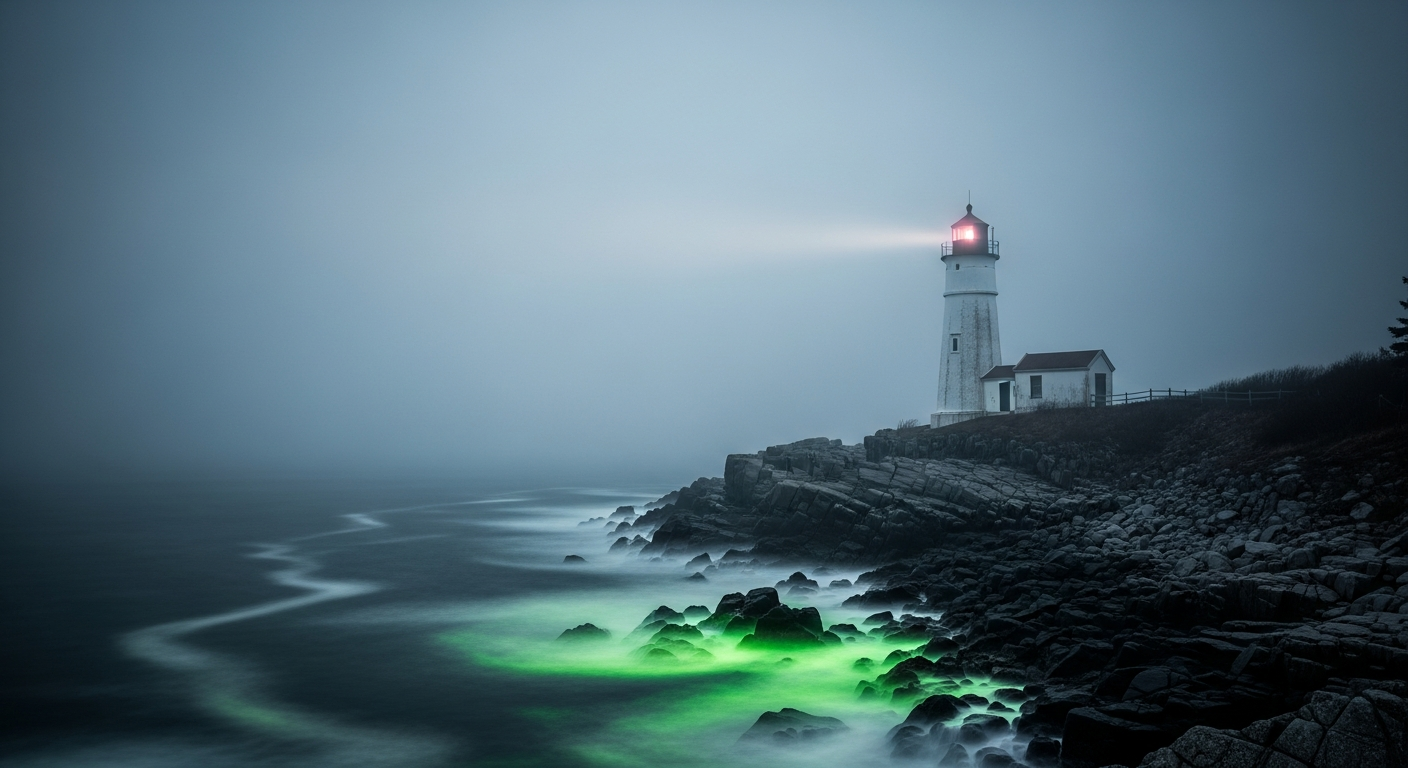
Off the coast near Biddeford stands Wood Island Lighthouse, first lit in 1808 at the urging of Thomas Jefferson and rebuilt in 1839. Its haunting traces to a single bad day in 1896.
The way the story is told: a tenant on the island named Howard Hobbs fell behind on his rent, and the landlord, Frederick Milliken, came to collect. The confrontation went catastrophically wrong, ending in death. Visitors and keepers since have reported the sound of footsteps with no body attached to them — Milliken and Hobbs, apparently still circling the same argument more than a century later. The lighthouse was eventually featured on the TV series Ghost Hunters, which is either evidence or a sign of how seriously the local community takes it, depending on your perspective.
The Friends of Wood Island Light offers tours of the island from May through October. Volunteers who have stayed overnight report an almost atmospheric quality to the unease — not sudden frights, but a low-level persistent wrongness, like a room that's been cold all winter.
Bucksport's Cursed Gravestone
In the eastern Maine town of Bucksport lies the most famous visual haunting in the state: the grave of Colonel Jonathan Buck, a Revolutionary War officer and local judge.
The legend holds that Buck, in his role as a judge during an era of witch-hunting hysteria, condemned a woman to death — and that as she died she cursed him, swearing she would dance on his grave. When a stain in the unmistakable shape of a leg and boot appeared on his monument, his descendants were horrified. They replaced the stone. The stain came back. They cleaned it, scrubbed it, tried again. It always returned.
You can go look at it. The boot-shaped outline is still on the Buck monument today. Geologists will tell you it's a natural flaw in the granite. The town will tell you to come decide for yourself.
Route 2A: A Tombstone Every Mile
Not every Maine haunting is tied to a single building. Stretching through the north woods, Route 2A earned such a deadly reputation among truckers that country singer Dick Curless wrote a song about it — 'A Tombstone Every Mile.' Drivers have long been reluctant to run the road's tight curves after dark, and the reasons given aren't only mechanical.
The road's signature apparition is a woman who appears at the roadside screaming that her husband is trapped in a wrecked car. Drivers who stop to help find no woman and no wreck — she's gone the moment they reach her. Others report the figure of a little girl wandering the shoulder, said to have died in a hit-and-run long ago. The asphalt is real, the fatalities are real, and the ghosts, true or not, keep good company with both.
Why These Stories Stick
There's a pattern worth noticing. Maine's most enduring hauntings aren't about random spookiness — they're about unfinished business. A widower suspected of murder. A rent dispute that turned fatal. A judge and the woman he condemned. A wife screaming for a husband no one can save. Think of a ghost story the way you'd think of a song stuck in your head: it loops because it never got to resolve. These places are the spots where Maine's history hit a sour note and simply never moved on.
So if you visit — Taunton Bay in Sullivan, the granite monument in Bucksport, the lighthouse off Biddeford, the dark curves of Route 2A — go in daylight if you're nervous. But know that the most reliably haunted hour in Maine has always been the same one: whenever the cold comes up out of the cellar, and the conversation you can't quite hear gets just clear enough to understand.
Sources for the historical details in this piece include the Bangor Daily News, the Sullivan-Sorrento Historical Society, and LiBrizzi and Boyd's documentary history of the Nelly Butler case.