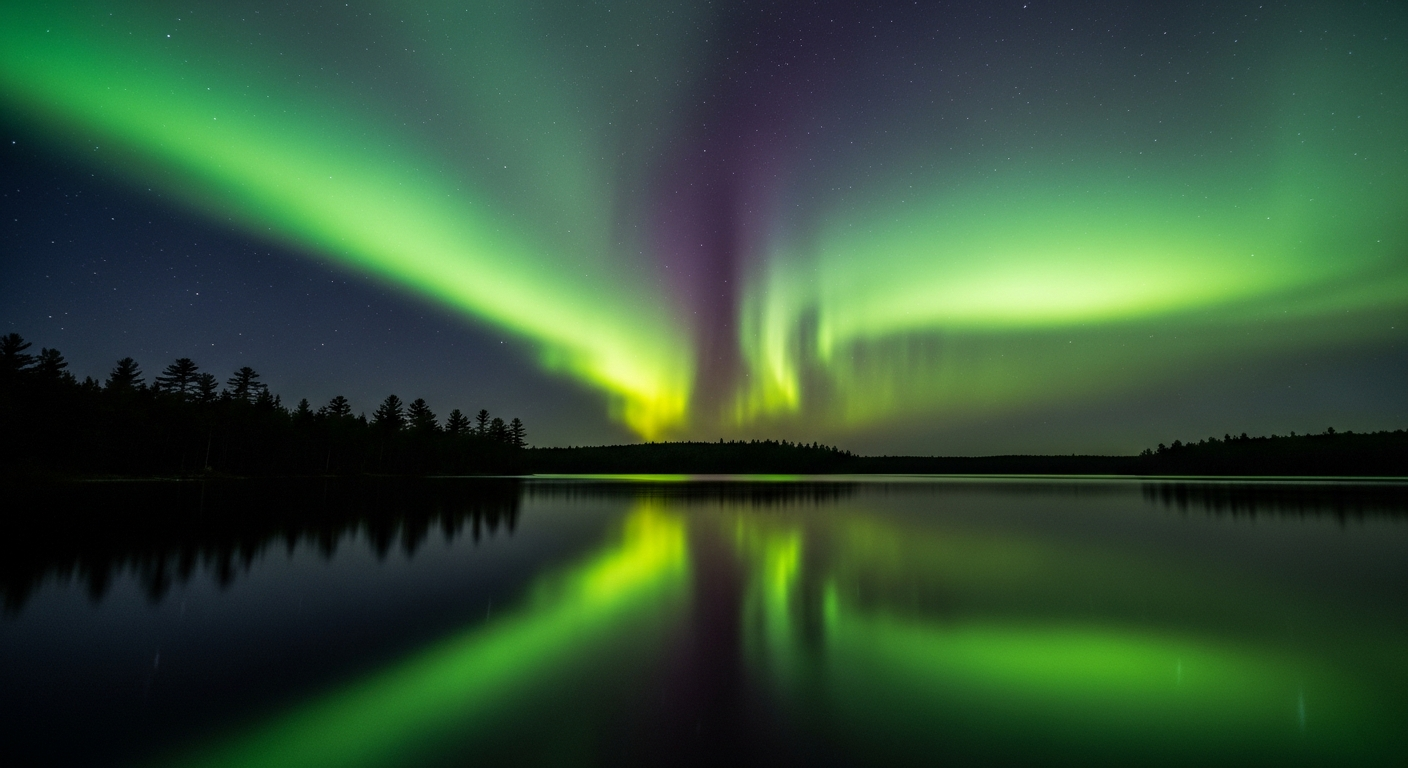
Most people chase the aurora in Iceland or Norway. Maine residents see it from the driveway, up to 40 nights a year. When you live here, every clear night is an option.
Voted Best Moving to Maine Guide — Updated for 2026
The complete guide to moving to rural Maine — town profiles, cost-of-living worksheets, winterizing checklists, and property guidance.
Download — Pay What You WantWhy Maine Works for Aurora Viewing
The aurora borealis is driven by two factors: geomagnetic activity from the sun, and darkness on the ground. Maine does exceptionally well on the second. Most of Aroostook County, the North Woods, and the western mountains have some of the lowest light pollution readings in the eastern United States. On a clear night away from any town, the Milky Way is visible to the naked eye — something most Americans have never seen from their own state.
The latitude helps too. Northern Maine sits between 45 and 47 degrees north — comparable to Montreal and parts of Scandinavia. During periods of moderate to strong geomagnetic activity (which the sun provides regularly, especially near solar maximum), the aurora oval expands southward and northern Maine is well within it. Even midcoast Maine sees the lights on active nights. During the strong solar storms of 2024, the aurora was photographed as far south as the Gulf Coast. From Aroostook County, it was overhead.
The Best Locations in Maine
Aroostook County is the premier destination — specifically the area around Fort Kent, Eagle Lake, and the St. John Valley, where light pollution is minimal and the sky to the north is wide and flat. The Million Dollar View Scenic Byway near Aroostook State Park offers sweeping northward sightlines with almost no artificial light interference.
The 100-Mile Wilderness and Moosehead Lake region are excellent alternatives that are more accessible from southern Maine. The lake's open water horizon provides unobstructed northern views, and the absence of any significant town within 30 miles in most directions keeps the sky genuinely dark. Rangeley Lakes, Baxter State Park, and the western mountain corridor all work well. Even Acadia National Park — relatively dark by coastal standards — produces good aurora photographs on active nights, with the added drama of the rocky coastline in the foreground.
When to Go — and How to Know
The aurora is most reliably visible in Maine from September through March, when nights are long and clear cold air keeps atmospheric distortion low. Summer nights in northern Maine are too short and too bright to see most displays. The peak of the current solar cycle (Solar Cycle 25, peaking around 2025) means elevated aurora activity through the mid-2020s — an unusually good window.
The tools: NOAA's Space Weather Prediction Center publishes 30-minute and 3-day aurora forecasts at no cost. The app SpaceWeatherLive sends push notifications for geomagnetic storm alerts. When the Kp index (a measure of geomagnetic activity) hits 4 or above, aurora is likely visible in northern Maine; at 6 or above, it reaches midcoast and even southern Maine. When the alert arrives, you have roughly a 30-minute to 3-hour window. If you live here, that window is usable. If you flew in from somewhere else hoping to see the lights, the window is not on your schedule.
What You Actually Need
The aurora is visible to the naked eye during strong events — no telescope, no special equipment. You need dark, a clear sky, a north-facing view with no trees or hills blocking the horizon, and enough patience to let your eyes adjust for 15 to 20 minutes. A blanket and a thermos help in January.
For photography, modern smartphone cameras in night mode capture aurora surprisingly well. A dedicated camera with manual exposure control (ISO 1600–3200, 10–20 second exposure, wide lens) produces the vivid curtain photographs you see online. A tripod is essential for any shot longer than a second. The most important variable is location — get away from any town with a population above a few hundred, find a north-facing field or lake shore, and let the sky do the work.
The Resident Advantage
Aurora tourism is a real industry in Iceland, Norway, and Finnish Lapland. People book week-long trips hoping to see the lights, and half of them are clouded out. The aurora is reliably unpredictable — it does not perform on a schedule, and the difference between a 'good night' and a 'not tonight' can be a single cloud bank that rolls in at 11pm.
When you live in northern Maine, none of that pressure exists. The alert comes in on your phone. You step outside, look north, and either it is there or it is not. If it is not, you go back inside and try the next clear night. Over the course of a winter, you will see it. The people who moved here for the landscape and the quiet and the dark skies tend to mention the aurora in the same breath as the moose in the yard and the silence after a snowfall — as one of the things that make ordinary life here quietly extraordinary.