Before refrigeration, Maine shipped Kennebec River ice to Calcutta, Havana, and Rio de Janeiro — one of the most unlikely industries in American history.
Voted Best Moving to Maine Guide — Updated for 2026
The complete guide to moving to rural Maine — town profiles, cost-of-living worksheets, winterizing checklists, and property guidance.
Download — Pay What You WantThe Idea That Should Not Have Worked
In 1806, a 23-year-old Boston merchant named Frederic Tudor loaded 130 tons of ice cut from a Massachusetts pond onto a ship and sailed it to Martinique. Almost all of it melted. He lost a fortune. He tried again. And again. By the time he perfected his insulation technique — packing ice in sawdust inside double-walled holds — he had pioneered one of the most improbable global commodities trades in history: natural ice harvested from New England and shipped to the tropics.
The Kennebec River in Maine became the center of this industry. The river froze thick — 18 to 22 inches in a good winter — and the ice was extraordinarily clear, free from the sediment that clouded pond ice further south. By the 1870s, the Kennebec was shipping over a million tons of ice annually to Boston, New York, New Orleans, Havana, Calcutta, and beyond.
A Town Built on Ice
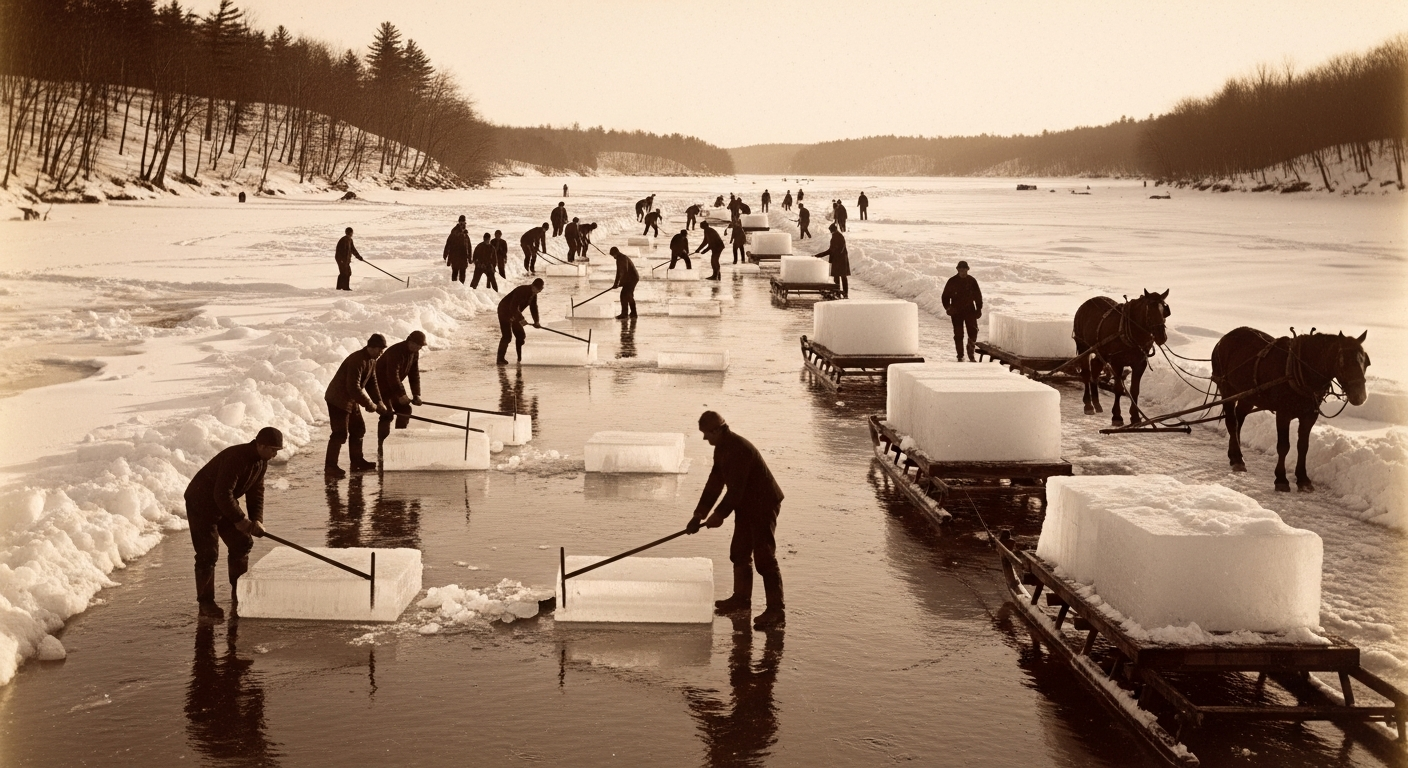
The town of Gardiner, on the Kennebec's western bank, became the capital of the ice trade. The icehouse complexes that lined the river could store hundreds of thousands of tons, and in harvest season — January and February, when the river was at its thickest — thousands of men worked the ice fields in shifts, cutting blocks with horse-drawn plows and hand saws, moving ice on chutes and conveyors into the great wooden houses that lined the bank.
The work was cold, dangerous, and precise. The ice had to be cut in uniform blocks — 22 by 44 inches was standard — so they would stack evenly and insulate each other during the voyage. A skilled ice cutter could score and cut hundreds of blocks in a day. The sawdust that insulated the icehouse storage came from Maine's mills. Almost everything in the operation was local.
The End of an Era
The mechanical ice machine was patented in the 1850s, but it took decades for manufactured ice to undercut the natural ice trade on price. By the 1890s, the Kennebec industry was in decline. The last major ice harvest on the Kennebec happened in the early 1930s.
What remains are the icehouse foundations along the riverbank — massive granite-and-timber footings that supported buildings larger than most modern warehouses — and the memory, in towns like Gardiner, Dresden, and Richmond, of an industry that once employed half the county in winter and connected a Maine river to ports on six continents. The Kennebec still freezes in cold winters. Nobody cuts it anymore.